
“Indexing for learning.”
Natalia Kurz used that phrase during a recent conversation with Rootline Robotics Co-Founder and CEO Andrew James at UC Davis, and it stayed with us.
Natalia was talking about balancing school with everything else she was pursuing. Rather than simply optimizing for grades, she described making choices that prioritized actually learning and understanding what she was working on.
The two were speaking at the opening session of the UC Davis Student Startup Center’s Startup Speaker Series. The phrase came up in the context of school, and it kept surfacing as a broader theme in their conversation: learning mattered as much as building.
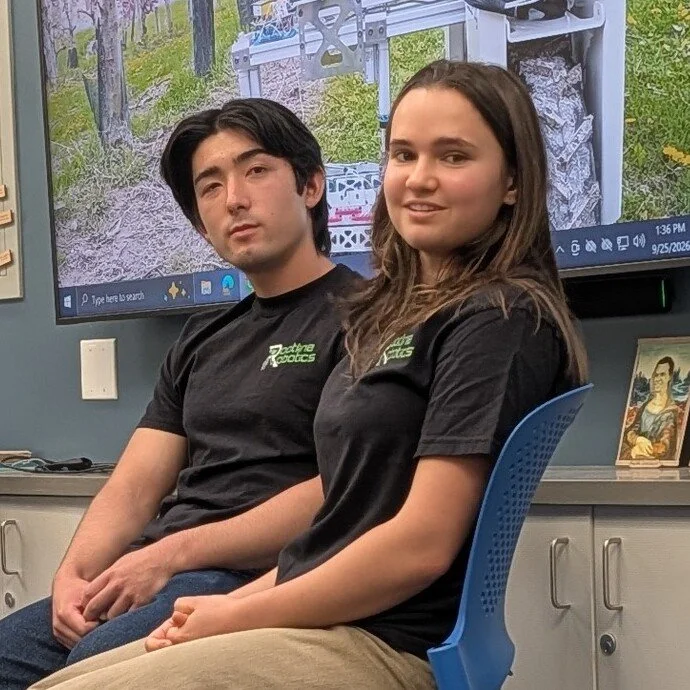
Rootline Robotics Co-Founder and CEO Andrew James, left, and Co-Founder and CPO Natalia Kurz during a UC Davis Student Startup Center speaker session.
Before Rootline Robotics, Natalia and Andrew were part of Cornell University’s Farm Robotics Challenge team. Their team went on to win the 2026 Challenge with an electric weeding system.
The project itself began much closer to home.
Andrew’s family operates an organic apple orchard in New York, where he had firsthand experience managing weed pressure. That experience helped motivate the original project, which the Cornell team initially developed with apple orchards in mind.
Winning the Farm Robotics Challenge was a major milestone, and it also opened the door to a $50,000 SAFE investment from Reservoir Farms, the 2026 Challenge’s Grand Prize sponsor.
Accepting the investment required the team to incorporate, helping turn what had been a student project into Rootline Robotics.
But becoming a company did not answer all the important questions. It only made the learning more consequential.
Winning didn’t end the learning
As Rootline’s work moved to California, the team began looking more closely at vineyards.
Part of the attraction was practical. Andrew had access to apple orchards in New York, but farms there could be separated by considerable travel time. In California, the density of vineyards gave the team access to many more growers within a relatively small geographic area.
That created an opportunity, but they still had to understand it.
Natalia described calling grower after grower, looking for people willing to talk with her about their operations and the problems they were experiencing. Those conversations helped the team better understand the market they were entering, how weed control looked in vineyard operations, and where their technology might fit.
That distinction matters.
They were not simply taking a robot they had already built and looking for someone who might want it. Even after winning the Challenge, they were still deepening their understanding of how the problem changed across crop systems and what growers would actually need from a solution.
Andrew reinforced the point during the conversation: if you want to understand a problem, you need to talk to the people experiencing it. A strong solution starts with a painful problem, not with a product you have already built and are now trying to find a use for.
Both also talked about the usefulness of what they called the “student card.” People are often willing to give students some of their time.
But Andrew emphasized that being a student is not a substitute for preparation.
He drew on his agricultural background and spent time learning about vineyards and the industry before approaching growers. The goal was to understand enough of their world to have a useful conversation when someone agreed to take the call.
In other words, you do not only learn from the people you call. You learn enough about them beforehand to ask better questions when they pick up.
Rootline’s experience points to a broader lesson: learning does not stop once a project works.
It is easy to think of problem discovery as something that happens at the beginning of a project, before the engineering starts. In practice, the two are harder to separate. As a solution moves into a new crop, market, or operating environment, the questions change. Assumptions that seemed reasonable in one setting may not hold in another.
The people using the technology are not outside the engineering process.
They are part of it.
A technically impressive system can still solve the wrong problem, add too much work to an operation, or address something growers simply do not value very highly. Discovering that early can be just as important as proving that a technical component works.
Build what you need to learn from
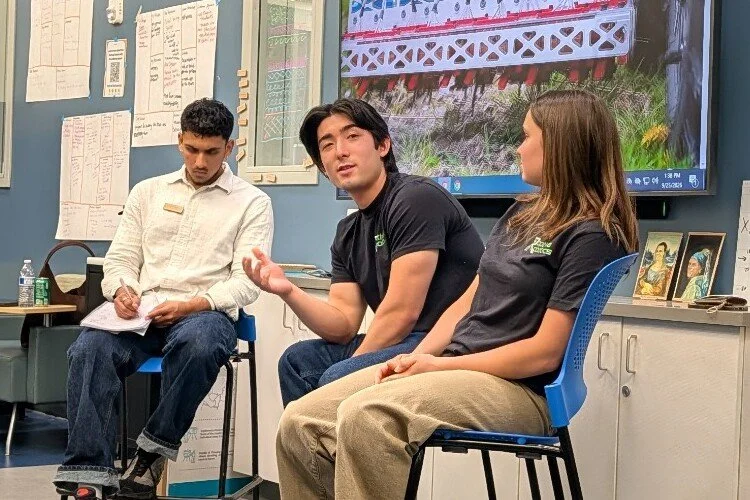
The same idea carried into Natalia and Andrew’s discussion of prototyping.
Natalia talked about finding the simplest version of an idea that can actually be tested. Instead of beginning with everything the finished product might eventually need to do, the more useful question is often narrower:
What does the product need to do now?
What uncertainty are you trying to resolve?
And what is the simplest thing you can build that will help you answer that question?
That approach becomes increasingly important as a project gets more complicated.
A robotic system might eventually need mobility, perception, autonomy, safety systems, ruggedized hardware, a user interface, reliable power, and any number of other capabilities. Trying to perfect all of them at once can consume enormous effort without necessarily answering the question that matters most.
Rootline’s current development work offered a useful example. The team is concentrating on the parts of its electric weeding system it still needs to understand and improve rather than trying to solve every element of the eventual machine at once.
Some capabilities can come later.
The immediate question is what the product needs to do at this stage of development—and what the team needs to learn from it before moving on.
That is not only a lesson for student robotics projects; it is the larger point of Rootline’s story.
A prototype does not always need to prove that an entire product works. Sometimes its most valuable job is to answer the next important question.
Indexing for learning
That brings us back to Natalia’s phrase.
The Farm Robotics Challenge is a competition. Teams should try to win it. Competition creates deadlines, expectations, and a reason to push a project further than students otherwise might.
But Rootline’s story is a reminder that winning is not the same thing as being finished.
Their project began around a problem Andrew knew from apple orchards in New York. The team developed a working solution and won the Farm Robotics Challenge. An investment helped push them toward forming a company. Moving to California opened a different agricultural environment, which led to more research, more conversations with growers, and more decisions about where their technology could be most useful.
Each milestone answered some questions and created new ones.
That may be the most durable lesson in their story: progress depends on learning what still needs to be learned.
Good innovation is not a straight progression from problem to solution. It is a process of repeatedly testing what you think you know: about the problem, the user, the environment, and the thing you are building.
Learning that your original idea does not work is useful.
Discovering that you misunderstood part of the problem is useful.
Finding out that something you thought mattered to a grower actually does not—and that something you overlooked matters quite a lot—is useful.
For the Farm Robotics Challenge, that is part of what the competition is meant to make possible: learning by building, testing, and revising.
The robots matter. The competition matters. Winning matters.
But so does learning: how to recognize a meaningful problem, talk with the people experiencing it, test an assumption, build something that produces useful evidence, and decide what needs to be learned next.
Rootline’s project keeps changing because the team keeps learning.
That is worth indexing for.